
Settlement Failure Cycle Structural Field Cards
THE SETTLEMENT FAILURE CYCLE
STRUCTURAL FIELD CARDS
10 Reference Cards · NSFC 071–080
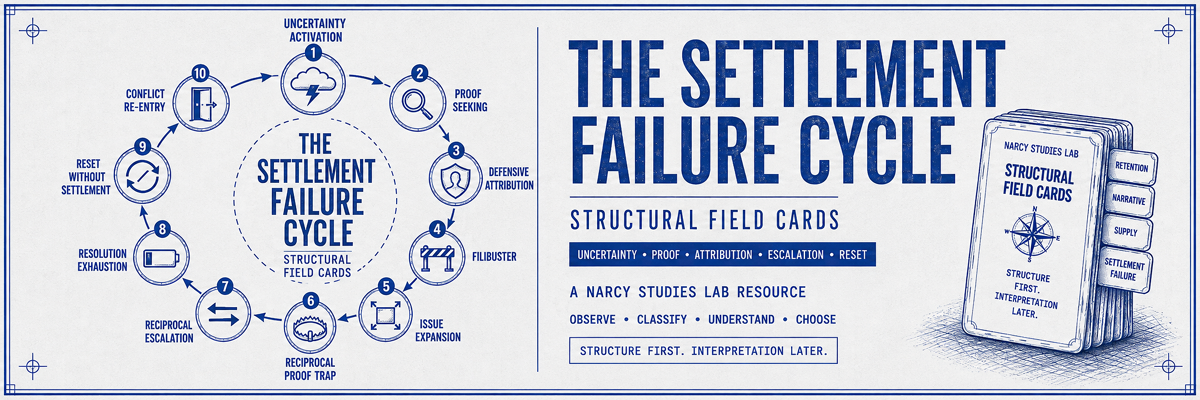
This Structural Field Card collection follows ten recognizable points where an attempt to settle a relational question can lose stability. The cycle begins when changing or incompatible signals activate uncertainty, moves through proof seeking and increasingly difficult interpretation, and may end in exhaustion, apparent reset, and conflict re-entry rather than durable settlement.
Series Observation
The Settlement Failure Cycle maps how a relational question can consume increasing amounts of communication while producing decreasing amounts of settlement. Uncertainty can activate proof seeking; attribution, filibuster, issue expansion, reciprocal proof, and escalation can consume capacity; exhaustion may then produce a reset that resembles resolution without settling the original uncertainty. Because the unsettled item remains available, later signal changes can reactivate the same architecture.
The Settlement Failure Cycle maps how a relational question can consume increasing amounts of communication while producing decreasing amounts of settlement. Uncertainty can activate proof seeking; attribution, filibuster, issue expansion, reciprocal proof, and escalation can consume capacity; exhaustion may then produce a reset that resembles resolution without settling the original uncertainty. Because the unsettled item remains available, later signal changes can reactivate the same architecture.
071 Uncertainty Activation
↓
072 Proof Seeking
↓
073 Defensive Attribution
↓
074 Filibuster
↓
075 Issue Expansion
↓
076 Reciprocal Proof Trap
↓
077 Reciprocal Escalation
↓
078 Resolution Exhaustion
↓
079 Reset Without Settlement
↓
080 Conflict Re-entry
↺
Settlement Failure Cycle Field Cards connect with the larger Structural Field Card hub, Psychological Effects, and related Narcy Studies Lab systems.